Luxury Real Estate Market Shifts in 2026: Why All-Cash Buyers Are Facing New Competition from Financed Deals


Last updated: February 28, 2026
Key Takeaways
- All-cash buyers are losing their competitive edge as mortgage rates decline and affluent buyers increasingly leverage financing to preserve liquidity and investment flexibility
- Inventory has surged more than 10% year-over-year nationally, with new listings jumping nearly 30% week-over-week in January 2026, creating more negotiation opportunities for financed buyers[3]
- International cash purchases remain strong with $56 billion in U.S. real estate transactions between April 2024 and March 2025, but financed domestic buyers are closing the gap[2]
- Market time for luxury properties above $2.5 million has improved to 156 days, allowing financed buyers more time to secure favorable terms[2]
- Luxury markets continue outperforming lower-priced segments due to K-shaped economic dynamics, with prices holding nearly flat for single-family homes while attached properties post gains[1][3]
- Buyer sophistication has increased dramatically, with purchasers analyzing risk, insurance costs, and climate exposure alongside traditional lifestyle factors[1]
- Geographic redistribution is accelerating as migration-driven markets in Florida, Nevada, Texas, and other regions capture demand from traditional luxury hubs[1]
- Property expectations have evolved beyond differentiators to baseline requirements including wellness design, integrated technology, and multigenerational living capabilities[1]
Quick Answer
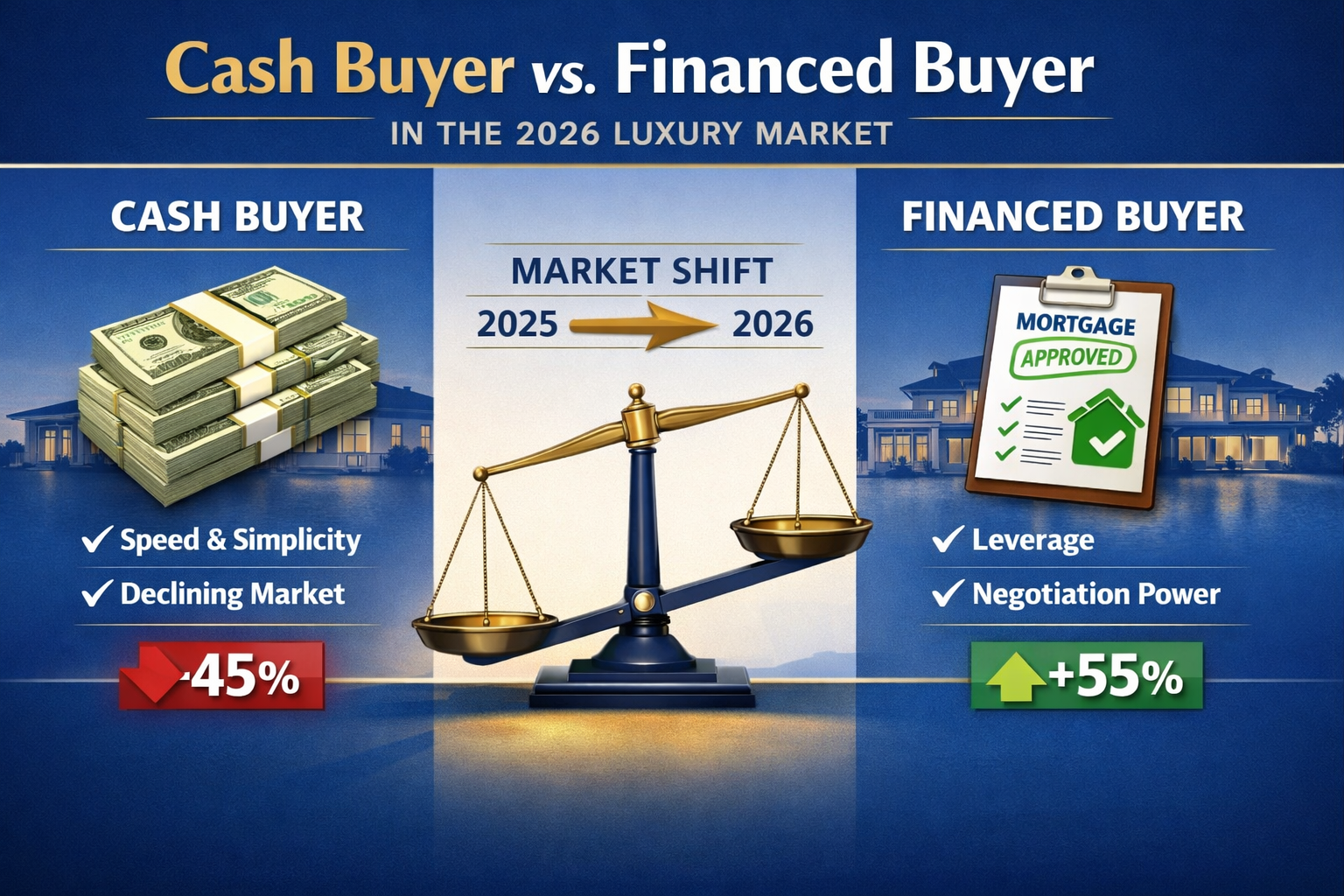
The luxury real estate market in 2026 is experiencing a fundamental shift as declining mortgage rates and improved financing options allow affluent buyers to compete effectively against traditional all-cash offers. With national inventory up more than 10% year-over-year and market time improving to 156 days for properties above $2.5 million, financed buyers now have both the time and leverage to negotiate competitive deals[2][3]. This rebalancing creates new dynamics for sellers and real estate professionals who can no longer assume cash offers automatically win.
What Are the Key Luxury Real Estate Market Shifts in 2026 Affecting Buyer Competition?
The luxury real estate landscape in 2026 is fundamentally different from previous years because financed buyers now compete on nearly equal footing with all-cash purchasers. This shift stems from three converging factors: declining interest rates, surging inventory levels, and sophisticated financing strategies that preserve buyer liquidity.
Sales activity in January 2026 closely mirrored January 2025, with single-family luxury sales down just 1.4% year-over-year, indicating market resilience rather than demand erosion[1]. This stability exists alongside a dramatic inventory increase—national listings are up more than 10% year-over-year, with new listings surging nearly 30% week-over-week in January, one of the strongest early-season increases since before 2020[3].
The Changing Competitive Landscape
For sellers, this means:
- Cash offers no longer guarantee faster closes or fewer contingencies
- Financed buyers with strong pre-approvals can negotiate more aggressively
- Pricing must be justified through property quality and relevance, not just market momentum[1]
For buyers, the advantages include:
- More time to conduct due diligence (market time at 156 days for $2.5M+ properties)[2]
- Ability to preserve cash for renovations, investments, or reserves
- Access to private banking solutions that rival cash transaction speeds
Common mistake: Sellers automatically accepting lower cash offers without evaluating the strength of financed buyers' pre-approvals and banking relationships.
How Are Interest Rates Influencing Luxury Real Estate Market Shifts in 2026?
Interest rates play a nuanced role in the luxury segment that differs significantly from lower-priced markets. Many affluent buyers purchase with cash or utilize private banking solutions, making rates more influential on timing and leverage strategies than overall demand[1].
The key difference in 2026 is that declining rates have made financing an attractive strategic choice rather than a necessity. Wealthy buyers increasingly recognize that tying up $3-5 million in a property purchase eliminates flexibility for other investments, business opportunities, or portfolio diversification.
Strategic Financing Advantages
| Strategy | Benefit | Best For |
|---|---|---|
| 30% Down Payment | Preserves 70% liquidity for investments | Buyers with strong investment portfolios |
| Private Banking Lines | Competitive rates, flexible terms | Ultra-high-net-worth individuals |
| Portfolio Loans | Customized underwriting, relationship-based | Buyers with complex income structures |
| Bridge Financing | Quick close like cash, refinance later | Buyers selling another property |
Choose financed deals if: You have investment opportunities yielding returns above your mortgage rate, want to maintain emergency reserves, or need to preserve liquidity for business operations.
Edge case: Some luxury buyers are using financing even when they could pay cash simply to establish or maintain credit relationships with private banks, which can provide future benefits beyond the property transaction.
Why Are All-Cash Buyers Losing Their Traditional Advantages?
All-cash buyers historically dominated luxury real estate because they offered speed, certainty, and simplicity. In 2026, these advantages have eroded significantly as financed buyers close the gap through sophisticated banking relationships and improved market conditions.
Between April 2024 and March 2025, international buyers purchased $56 billion worth of U.S. existing homes with nearly half paying all cash at record-high median purchase prices[2]. However, domestic financed buyers are now competing effectively because:
The Erosion of Cash Advantages
Speed: Private banking solutions and portfolio loans can close in 15-21 days, comparable to all-cash transactions.
Certainty: Pre-underwritten financing with committed funds eliminates traditional financing contingencies.
Negotiation Power: With 156 days of market time for properties above $2.5 million[2], sellers can afford to wait for the best offer rather than accepting the fastest one.
Inspection Leverage: Financed buyers can negotiate repairs or credits that cash buyers often waive to remain competitive.
Market Data Supporting the Shift
Orange County's super-prime market ($10M+) recorded 33 sales in Q3 2025 with only a 3% quarter-over-quarter adjustment, compared to 28% decline in Dubai and 38% drop in New York[2]. This resilience suggests that quality buyers—whether cash or financed—are finding opportunities in stable markets.
Common mistake: Cash buyers assuming their offer will automatically be preferred without considering that sellers may value a higher financed offer with strong pre-approval over a lower cash bid.
What Geographic Markets Are Leading Luxury Real Estate Market Shifts in 2026?
The luxury market is experiencing geographic redistribution as migration patterns and lifestyle preferences reshape where affluent buyers invest. Traditional luxury hubs remain resilient at ultra-luxury levels, but migration-driven markets are capturing increased demand[1].
High-Growth Luxury Markets
Migration-Driven Winners:
- Florida: No state income tax, lifestyle amenities, international appeal
- Nevada: Tax advantages, urban luxury in Las Vegas, Lake Tahoe proximity
- Texas: Business-friendly environment, affordable luxury relative to coastal markets
- Calgary, Ottawa, Montreal: Canadian markets benefiting from domestic redistribution
Traditional Hubs Holding Strong:
- New York, Los Angeles, Vancouver, Toronto: Ultra-luxury ($10M+) segments remain resilient
- Orange County: Super-prime market showing only 3% quarterly adjustment[2]
Decision Framework for Geographic Investment
Choose migration markets if: You're seeking appreciation potential, tax advantages, or lifestyle-driven second/third homes where younger Baby Boomers are downsizing primary residences while acquiring additional properties[1].
Choose traditional hubs if: You prioritize established luxury infrastructure, international buyer pools, or ultra-prime positioning where scarcity maintains value.
Edge case: Some buyers are purchasing in both categories—maintaining a traditional hub property for business/social positioning while adding migration-market properties for tax optimization and lifestyle flexibility.
How Are Buyer Demographics Changing the Luxury Real Estate Market in 2026?
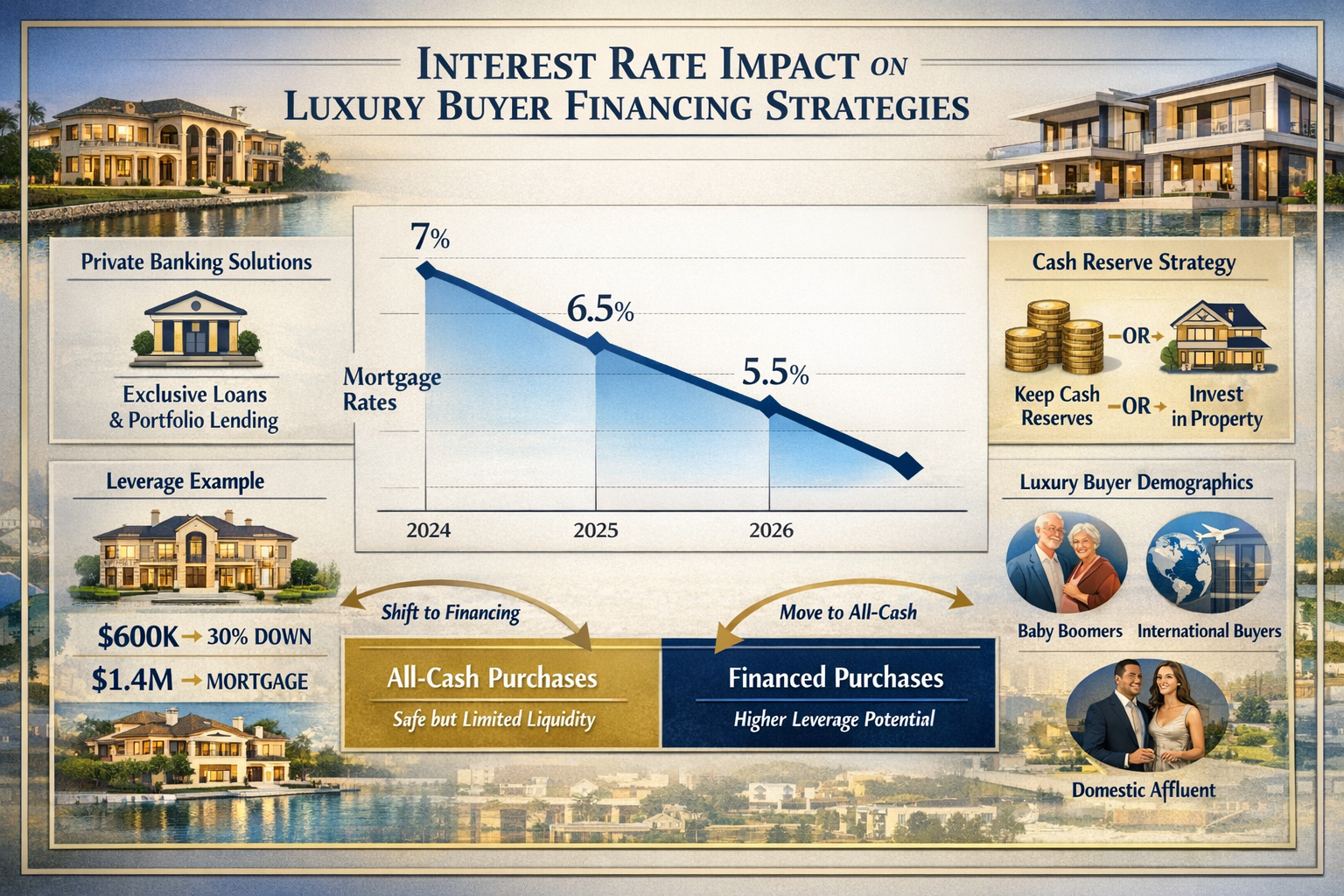
Buyer demographics in 2026 reflect a more sophisticated, analytical, and diverse pool of luxury purchasers compared to previous market cycles. This evolution directly impacts how all-cash and financed buyers compete.
Key Demographic Shifts
Younger Baby Boomers are downsizing primary residences while acquiring lifestyle-driven second and third homes, creating demand in both urban luxury condos and resort/recreation markets[1].
Mid-Luxury Segment Growth shows rising demand where quality design and usability matter more than scale, favoring properties in the $1-3M range over oversized estates.
International Buyers remain active with $56 billion in purchases, but their focus has shifted toward markets offering stability, tax advantages, and lifestyle amenities rather than pure investment appreciation[2].
Sophistication and Analysis
Buyers in 2026 are more analytical, factoring in:
- Risk assessment and portfolio diversification
- Insurance costs and availability
- Climate exposure and environmental regulation
- Long-term maintenance and operating expenses
- Resale potential and market liquidity
This sophistication benefits financed buyers because they can demonstrate financial strength through comprehensive underwriting while preserving capital for the additional costs and contingencies that luxury ownership requires.
Common mistake: Sellers assuming all-cash buyers are more qualified without evaluating whether financed buyers have actually conducted more thorough due diligence and financial planning.
What Property Features Are Driving Luxury Real Estate Market Shifts in 2026?
Property expectations have evolved dramatically, with features that were once differentiators now serving as baseline requirements. This shift affects how both cash and financed buyers evaluate properties and structure offers[1].
Baseline Expectations (No Longer Differentiators)
✅ Wellness-centric design: Home gyms, spa bathrooms, air quality systems, natural light optimization
✅ Seamless technology integration: Smart home systems, integrated security, high-speed connectivity infrastructure
✅ Turnkey condition: Move-in ready with contemporary finishes and systems
✅ Flexible layouts: Spaces adaptable for hybrid work, entertainment, and lifestyle changes
✅ Multigenerational living capabilities: Separate living quarters, accessibility features, privacy zones
True Differentiators in 2026
🏆 Exceptional location: Proximity to amenities, views, privacy, climate resilience
🏆 Architectural significance: Unique design, renowned architects, historical importance
🏆 Sustainable systems: Solar, geothermal, water conservation, net-zero capabilities
🏆 Outdoor integration: Seamless indoor-outdoor living, landscaping, recreational amenities
Impact on Financing Decisions
Financed buyers often allocate capital strategically toward properties meeting baseline expectations while preserving funds for customization and upgrades. Cash buyers may overpay for turnkey properties to avoid the complexity of renovation financing.
Choose financed deals if: The property needs minor updates or customization that you can fund separately, allowing you to negotiate a better purchase price while maintaining renovation capital.
How Should Sellers Adapt to Luxury Real Estate Market Shifts in 2026?
Sellers in 2026 must justify pricing through quality and relevance rather than relying on market momentum alone[1]. The increased competition from financed buyers creates both challenges and opportunities for strategic sellers.
Strategic Seller Adaptations
1. Evaluate All Offers Holistically
- Review financing strength, not just cash versus financed
- Consider net proceeds after potential negotiations
- Assess buyer motivation and timeline flexibility
2. Price Based on Market Reality
- Flat to slightly positive price gains expected across most markets[1]
- Single-family prices holding nearly flat
- Attached properties posting meaningful gains
3. Highlight Baseline Expectations
- Document wellness features, technology systems, and flexibility
- Provide operating cost data and efficiency metrics
- Demonstrate turnkey condition and recent updates
4. Prepare for Sophisticated Due Diligence
- Expect detailed inspections and analysis
- Have documentation ready for all systems and improvements
- Be transparent about insurance, HOA, and regulatory factors
Common Seller Mistakes
❌ Automatically accepting cash offers without negotiation
❌ Overpricing based on 2021-2022 market dynamics
❌ Failing to address baseline expectations before listing
❌ Dismissing financed buyers with strong pre-approvals
Edge case: Some sellers are offering financing incentives (rate buydowns, closing cost credits) to attract financed buyers who can pay higher purchase prices, resulting in better net proceeds than lower cash offers.
What Role Are Real Estate Professionals Playing in These Market Shifts?
Real estate professionals navigating luxury market shifts in 2026 must educate clients on the changing competitive dynamics between cash and financed buyers while providing strategic guidance based on individual circumstances.
Professional Value Propositions
For Buyer Representation:
- Connecting clients with private banking solutions
- Structuring competitive financed offers
- Identifying properties where financing provides negotiation leverage
- Analyzing total cost of ownership beyond purchase price
For Seller Representation:
- Evaluating offer strength beyond cash/financed distinction
- Positioning properties to meet baseline expectations
- Pricing strategies that reflect current market dynamics
- Marketing to both domestic and international buyer pools
Market Knowledge Requirements
Professionals must understand:
- Current interest rate environments and private banking options
- Geographic market variations and migration patterns
- Demographic shifts and buyer motivation factors
- Property feature expectations and true differentiators
Common mistake: Agents advising sellers to automatically accept cash offers without analyzing the financial strength and motivation of financed buyers who may ultimately pay more and close just as quickly.
What Does the Future Hold for Luxury Real Estate Beyond 2026?
The competitive rebalancing between all-cash and financed luxury buyers represents a structural shift rather than a temporary market condition. Several factors suggest this dynamic will persist and potentially intensify.
Factors Supporting Continued Competition
Demographic trends: Younger luxury buyers (Gen X and elder Millennials) are more comfortable with strategic leverage and less likely to view all-cash purchases as status symbols.
Investment sophistication: Wealth management advisors increasingly recommend preserving liquidity over tying up capital in real estate, even for ultra-high-net-worth clients.
Banking innovation: Private banking solutions continue evolving with faster underwriting, more flexible terms, and relationship-based lending that rivals cash transaction efficiency.
Market normalization: As inventory levels stabilize and market time extends, the urgency that favored cash buyers diminishes.
Potential Disruptors
⚠️ Interest rate volatility: Significant rate increases could temporarily shift advantage back to cash buyers
⚠️ Economic recession: Credit tightening would favor cash buyers with immediate liquidity
⚠️ International policy changes: Regulatory shifts affecting foreign investment could alter cash buyer pools
⚠️ Climate events: Insurance availability and cost could make financing more difficult in certain markets
Edge case: Some markets may see bifurcation where ultra-luxury ($10M+) remains cash-dominated while mid-luxury ($1-5M) becomes primarily financed, creating distinct competitive dynamics within the broader luxury segment.
Conclusion
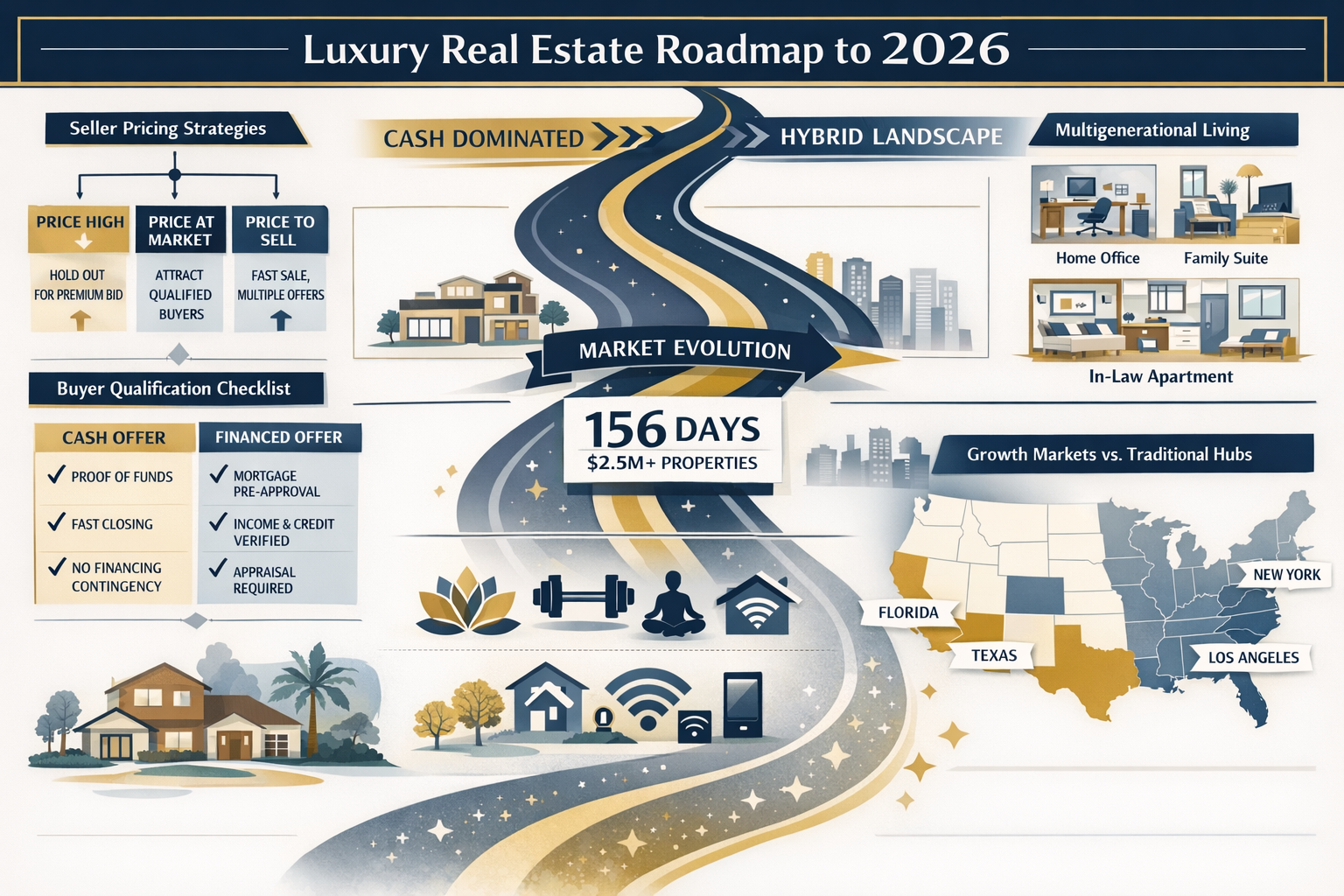
The luxury real estate market shifts in 2026 represent a fundamental rebalancing of competitive dynamics between all-cash and financed buyers. With inventory up more than 10% year-over-year, market time improving to 156 days for properties above $2.5 million, and sophisticated financing options rivaling cash transaction efficiency, the automatic advantages that cash buyers once enjoyed have significantly eroded[2][3].
For buyers, this environment offers strategic opportunities to leverage financing while preserving capital for investments, renovations, and reserves. The key is working with private banking relationships that can provide competitive terms and close quickly.
For sellers, success requires evaluating offers holistically rather than automatically favoring cash, pricing based on current market realities rather than past momentum, and ensuring properties meet the baseline expectations that sophisticated buyers now demand[1].
For real estate professionals, adding value means understanding the nuances of private banking solutions, educating clients on strategic financing advantages, and structuring offers that compete effectively regardless of funding source.
Actionable Next Steps
- Buyers: Establish private banking relationships before house hunting to understand your financing options and speed-to-close capabilities
- Sellers: Interview agents who understand both cash and financed buyer dynamics and can evaluate offer strength beyond surface-level distinctions
- Professionals: Develop relationships with private banks and portfolio lenders to provide clients with competitive financing alternatives
- Investors: Analyze markets experiencing geographic redistribution (Florida, Texas, Nevada) where luxury demand is growing alongside traditional hubs[1]
- All parties: Factor in the total cost of ownership including insurance, climate risk, and operating expenses rather than focusing solely on purchase price
The luxury real estate market in 2026 rewards sophistication, strategic thinking, and adaptability over the simple ability to write a check. Those who recognize and leverage these shifts will find opportunities that others overlook.
FAQ
Q: Are all-cash offers still preferred in luxury real estate? Cash offers remain attractive but no longer automatically win. Sellers increasingly evaluate financing strength, offer price, and contingencies holistically rather than defaulting to cash buyers, especially when financed offers are higher and backed by strong pre-approvals.
Q: How quickly can financed luxury buyers close compared to cash buyers? Private banking solutions and portfolio loans can close in 15-21 days, comparable to all-cash transactions. Traditional mortgages may take 30-45 days, but pre-underwritten financing eliminates much of the uncertainty that previously favored cash.
Q: What percentage of luxury buyers are using financing in 2026? While international buyers pay cash nearly 50% of the time, domestic luxury buyers increasingly leverage financing to preserve liquidity and investment flexibility, with the exact percentage varying by market and price point[2].
Q: Should I pay cash for a luxury home if I can afford it? Not necessarily. If you have investment opportunities yielding returns above your mortgage rate, need business liquidity, or want portfolio diversification, financing may be strategically superior even if you could pay cash.
Q: What markets are seeing the strongest luxury real estate growth in 2026? Migration-driven markets in Florida, Nevada, Texas, Calgary, Ottawa, and Montreal are capturing increased luxury demand while traditional hubs like New York, Los Angeles, and Toronto remain resilient at ultra-luxury levels[1].
Q: How has market time changed for luxury properties? Expected market time for luxury homes priced above $2.5 million has improved to 156 days, the strongest level since March 2025, giving financed buyers more time to secure favorable terms and complete due diligence[2].
Q: What property features are most important to luxury buyers in 2026? Wellness-centric design, integrated technology, turnkey condition, flexible layouts, and multigenerational living capabilities are now baseline expectations rather than differentiators, with location and architectural significance serving as true distinguishing factors[1].
Q: Are luxury home prices increasing or decreasing in 2026? Flat to slightly positive price gains are anticipated across most established luxury markets, with single-family prices holding nearly flat while attached properties post meaningful gains, indicating stability rather than dramatic appreciation or decline[1].
Q: How are international buyers affecting the luxury market? International buyers purchased $56 billion in U.S. real estate between April 2024 and March 2025, with nearly half paying all cash, but domestic financed buyers are increasingly competitive due to improved financing options and market conditions[2].
Q: What's the biggest mistake luxury sellers make in 2026? Automatically accepting lower cash offers without evaluating the strength of financed buyers' pre-approvals, banking relationships, and willingness to pay higher prices while closing nearly as quickly.
Q: Should luxury buyers waive inspections to compete with cash offers? No. With market time at 156 days for properties above $2.5 million, buyers have leverage to conduct thorough due diligence. Strong financed offers with reasonable contingencies often win over cash offers that waive protections but bid lower[2].
Q: How do private banking solutions differ from traditional mortgages? Private banking solutions offer relationship-based underwriting, faster closes (15-21 days), more flexible terms, and customized structures for high-net-worth individuals with complex income sources, making them competitive with all-cash transactions.
References
[1] Market Momentum What Lies Ahead For 2026 - https://www.rismedia.com/2026/02/19/market-momentum-what-lies-ahead-for-2026/
[2] The New Era Of Orange County Luxury Homes In 2026 - https://stavrosgroup.com/blog/the-new-era-of-orange-county-luxury-homes-in-2026/
[3] The Current State Of The Real Estate Market February 2026 A Shift Toward Stability - https://libtitle.com/the-current-state-of-the-real-estate-market-february-2026-a-shift-toward-stability/